 Add to Chrome
 Add to Firefox
 Add to Edge
Self-Prompting Small Language Models for Privacy-Sensitive Clinical Information Extraction
May 05, 2026
Clinical named entity recognition from dental progress notes is challenging because documentation is highly unstructured, domain-specific, and often privacy-sensitive. We developed a locally deployable framework that enables small language models to self-generate, verify, refine, and evaluate entity-specific prompts for extracting multiple clinical entities from dental notes. Using 1,200 annotated notes, we evaluated candidate open-weight models with multi-prompt ensemble inference and further adapted selected models using QLoRA-based supervised fine-tuning and direct preference optimization. Model performance varied substantially, highlighting the need for task-specific evaluation rather than reliance on generic benchmarks. Qwen2.5-14B-Instruct achieved the strongest baseline performance. After DPO, Qwen2.5-14B-Instruct and Llama-3.1-8B-Instruct achieved micro/macro F1 scores of 0.864/0.837 and 0.806/0.797, respectively. These findings suggest that automated prompt optimization combined with lightweight preference-based post-training can support scalable clinical information extraction using locally deployed small language models.

Dental CLAIRES: Contrastive LAnguage Image REtrieval Search for Dental Research
Jun 27, 2023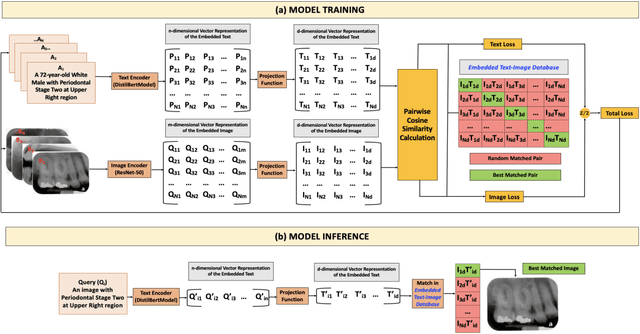
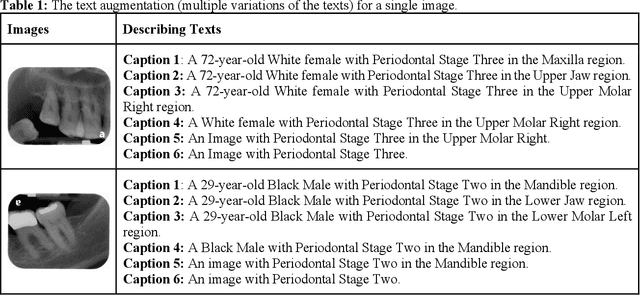
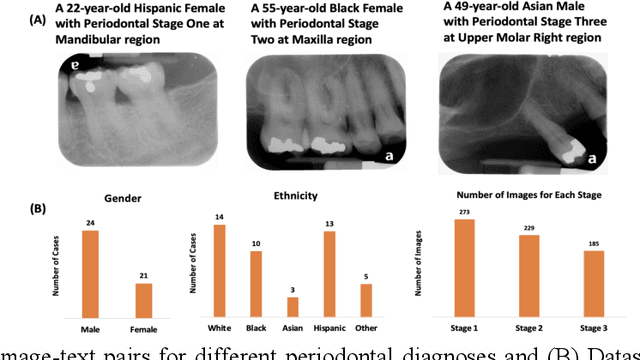
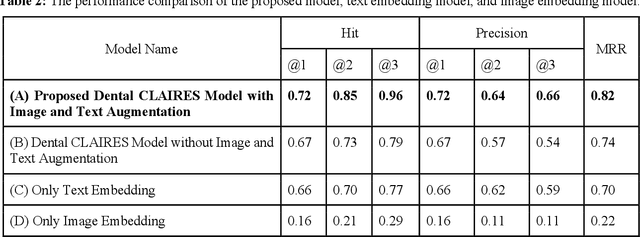
Learning about diagnostic features and related clinical information from dental radiographs is important for dental research. However, the lack of expert-annotated data and convenient search tools poses challenges. Our primary objective is to design a search tool that uses a user's query for oral-related research. The proposed framework, Contrastive LAnguage Image REtrieval Search for dental research, Dental CLAIRES, utilizes periapical radiographs and associated clinical details such as periodontal diagnosis, demographic information to retrieve the best-matched images based on the text query. We applied a contrastive representation learning method to find images described by the user's text by maximizing the similarity score of positive pairs (true pairs) and minimizing the score of negative pairs (random pairs). Our model achieved a hit@3 ratio of 96% and a Mean Reciprocal Rank (MRR) of 0.82. We also designed a graphical user interface that allows researchers to verify the model's performance with interactions.
* 10 pages, 7 figures, 4 tables
An End-to-end Entangled Segmentation and Classification Convolutional Neural Network for Periodontitis Stage Grading from Periapical Radiographic Images
Sep 27, 2021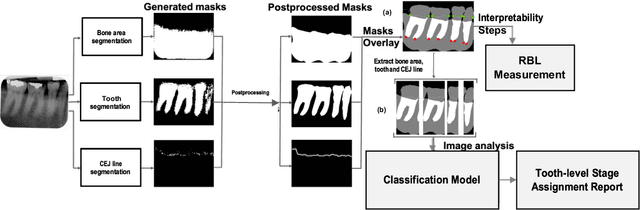
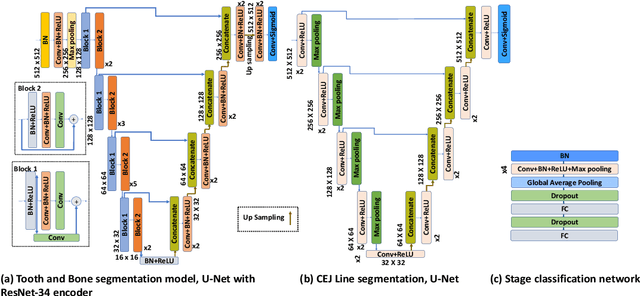
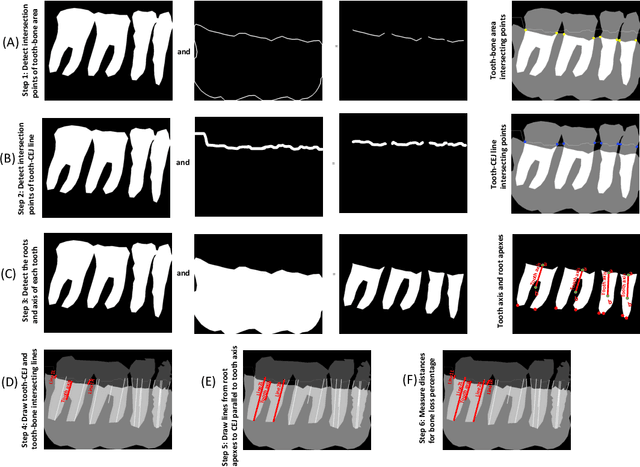
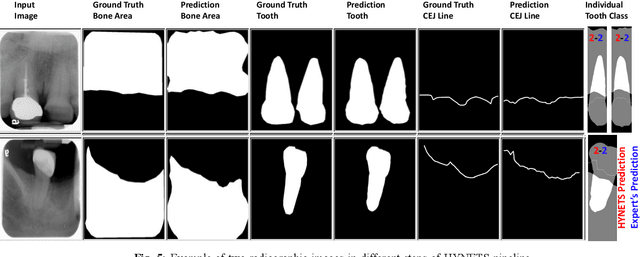
Periodontitis is a biofilm-related chronic inflammatory disease characterized by gingivitis and bone loss in the teeth area. Approximately 61 million adults over 30 suffer from periodontitis (42.2%), with 7.8% having severe periodontitis in the United States. The measurement of radiographic bone loss (RBL) is necessary to make a correct periodontal diagnosis, especially if the comprehensive and longitudinal periodontal mapping is unavailable. However, doctors can interpret X-rays differently depending on their experience and knowledge. Computerized diagnosis support for doctors sheds light on making the diagnosis with high accuracy and consistency and drawing up an appropriate treatment plan for preventing or controlling periodontitis. We developed an end-to-end deep learning network HYNETS (Hybrid NETwork for pEriodoNTiTiS STagES from radiograpH) by integrating segmentation and classification tasks for grading periodontitis from periapical radiographic images. HYNETS leverages a multi-task learning strategy by combining a set of segmentation networks and a classification network to provide an end-to-end interpretable solution and highly accurate and consistent results. HYNETS achieved the average dice coefficient of 0.96 and 0.94 for the bone area and tooth segmentation and the average AUC of 0.97 for periodontitis stage assignment. Additionally, conventional image processing techniques provide RBL measurements and build transparency and trust in the model's prediction. HYNETS will potentially transform clinical diagnosis from a manual time-consuming, and error-prone task to an efficient and automated periodontitis stage assignment based on periapical radiographic images.